The Hanging Houses of Cuenca
Under an hour by fast train, medieval Cuenca balances its famous houses over a river gorge — but the AVE lands five kilometers out, and the whole town only makes sense from the footbridge across the canyon.
The short version
- AVE trains run Atocha to Cuenca Fernando Zóbel in about 55 minutes — the station sits out of town per the alarm, with the L1/L2 shuttle timed to arrivals; the slower regional line serves the old-town-adjacent station at three times the journey, which settles the choice; fares at renfe.com.
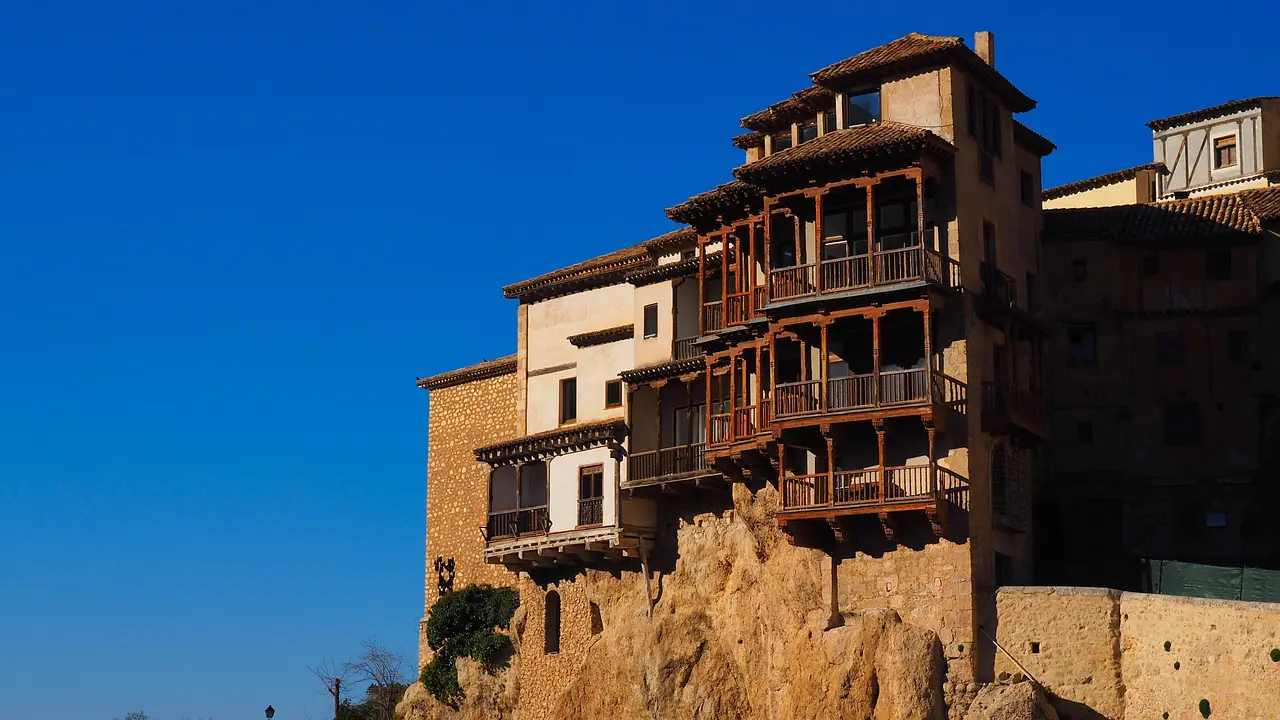
- The Casas Colgadas — the hanging houses — cantilever their wooden balconies over the Huécar gorge as the town’s emblem: three survive of the medieval cliff-edge row, restored and startling from the right angle.
- That angle is the San Pablo footbridge: the 1902 iron span across the gorge, gently swaying, delivering the postcard composition and a look straight down that tests the casual.
- Inside the hanging houses lives the Museo de Arte Abstracto Español — the Juan March foundation’s abstract collection in medieval rooms over the void, one of Spain’s great small museums at a modest-to-free door.
- The cathedral anchors the Plaza Mayor with some of Spain’s earliest Gothic and windows worth the extra chapel ticket; the old town’s painted facades stack up the ridge behind it.
- The gorge walks — down along the Huécar, up to the Barrio del Castillo viewpoints — frame the whole balancing act; the parador across the bridge (a converted convent) pours coffee with the definitive view.

Getting there
Atocha’s Levante-line AVEs make Cuenca an easy morning: 55 minutes of meseta, then the alarm’s shuttle handling the five-kilometer gap — a few euros, timed to trains, and dropping you at the old town’s foot. The return shuttle works the same trick in reverse; note the last workable train and let the day breathe inside it. Drivers do two hours of A-3 and park below the old town; the regional-train romance costs three hours each way and is filed under some-other-trip.
The day
Cross the San Pablo bridge first, per the alarm — the hanging houses composed across the gorge, the parador behind you, and the photograph banked before the light flattens. Recross into the old town: the abstract museum inside the houses themselves (the building is half the collection’s argument), the cathedral’s Gothic and its alabaster light, and the Plaza Mayor’s arcaded lean. Lunch runs Castilian-Manchegan — morteruelo for the committed, ajoarriero for the rest, Manchego regardless. The afternoon climbs to the Castillo viewpoints for the full gorge geometry, then descends the Huécar path where the houses hang overhead and the poplars do the autumn work. Coffee at the parador closes the circle at the view where the day started; the shuttle-and-AVE assembly runs you home by dinner.
When to go
April to June and September to October give the gorge its green and gold and the streets their walking weather; the meseta’s summer bakes the climbs and argues for morning bridges and museum middays. Autumn’s poplar turn along the Huécar is the photographer’s slot. Winter runs cold, clear, and nearly private — the abstract museum and the cathedral don’t care, and the bridge photograph gains drama from bare trees. Easter’s processions fill the town deliberately; ordinary weekends fill it gently; midweek is Cuenca at its own pace.
Frequently Asked Questions
Why is the station so far out?
The high-speed line’s geometry — Fernando Zóbel serves the Madrid–Valencia trunk, and Cuenca gets the stop at the cost of the gap. The shuttle system exists precisely for this and works; the alarm’s follow-the-crowd instruction is the entire skill required.
Are the hanging houses original?
Medieval in origin, heavily restored in the 20th century — three survivors of a longer cliff-edge row, rebuilt honestly rather than faked. The museum’s occupation is part of the preservation story: the houses work for a living.
Is the abstract museum worth it for non-devotees?
Yes — Chillida, Tàpies, and Saura in whitewashed medieval rooms with gorge light through the balconies; the setting converts skeptics the collection alone might not. An hour covers it; the balcony views are included in every ticket.
Cuenca or Toledo from Madrid?
Toledo (documented on this network) for the layered imperial city at half the distance; Cuenca for the gorge drama and the quieter register. Toledo is the essential; Cuenca is the connoisseur’s second — and the AVE makes them equally easy.
What’s across the bridge besides the parador?
The San Pablo convent (now the parador), the gorge-edge path toward the Júcar side, and the best free viewpoints in town. Non-guests use the parador café freely — the terrace coffee is the cheapest great view in Castile.