Madrid Day Tours
I’m Serious Day Tour Man AI, your day trip expert. Ask me anything — where to go, how to get there, and what’s actually worth your day.
Madrid sits inside Spain’s densest ring of preserved history, and the fast trains have collapsed the distances: the city of three faiths is thirty-three minutes away, a two-thousand-year-old aqueduct without a drop of mortar is twenty-seven, and the hanging houses of Cuenca are under an hour. Half of Castile is now a commuter ride.
The mechanics that matter: El Escorial closes Mondays and runs free-entry windows worth knowing, Segovia’s castle caps its tower visits by the minute, and Madrid’s own great museums give away their final hours daily — the schedule is in the city block.
Here’s what’s worth a day, with real times and honest trade-offs.

Popular Day Trips

Toledo
The easiest big day trip in Spain — 33 minutes by train

Segovia
Thirty minutes by fast train, with a catch at each end

El Escorial
An empire’s headquarters, built into a granite grid

Ávila
A thousand meters up, ringed by medieval walls
Cuenca
Houses hung over a gorge, under an hour by train

Salamanca
The university city that glows in golden sandstone

Aranjuez
The Bourbons’ spring retreat, under an hour south
Toledo — The City of Three Faiths
Thirty-three minutes south by AVE (the station itself, a neo-Mudéjar jewel, starts the lesson), Toledo stacks Christian, Muslim, and Jewish Spain onto one granite hill in the Tagus’s loop — the imperial capital before Madrid existed, preserved whole because history moved the court and left the city behind.
The circuit: the cathedral first — Spain’s Gothic heavyweight, where the Transparente’s baroque light-shaft and the sacristy’s El Greco wall justify the ticket alone — then the El Greco trail (the Burial of the Count of Orgaz in Santo Tomé is the single painting worth the queue), the two surviving synagogues (Santa María la Blanca’s white horseshoe forest and El Tránsito’s Mudéjar splendor with the Sephardic Museum), and the Cristo de la Luz mosque, the tenth century intact at chapel scale. The damascene and marzipan economies are the real local crafts, bought from workshops over stalls.
Three rules apply: the hill is real — the escalator banks from the Safont side beat the climb, and the Alcázar-to-cathedral spine walks downhill best — midday coaches flood the axis (the AVE’s early trains beat them by two hours), and the miradores across the river (Piedra del Rey Moro at dusk) supply the view El Greco painted. Full day, endlessly refillable.
Read the full Toledo day-trip page.
Segovia — The Aqueduct and the Ship
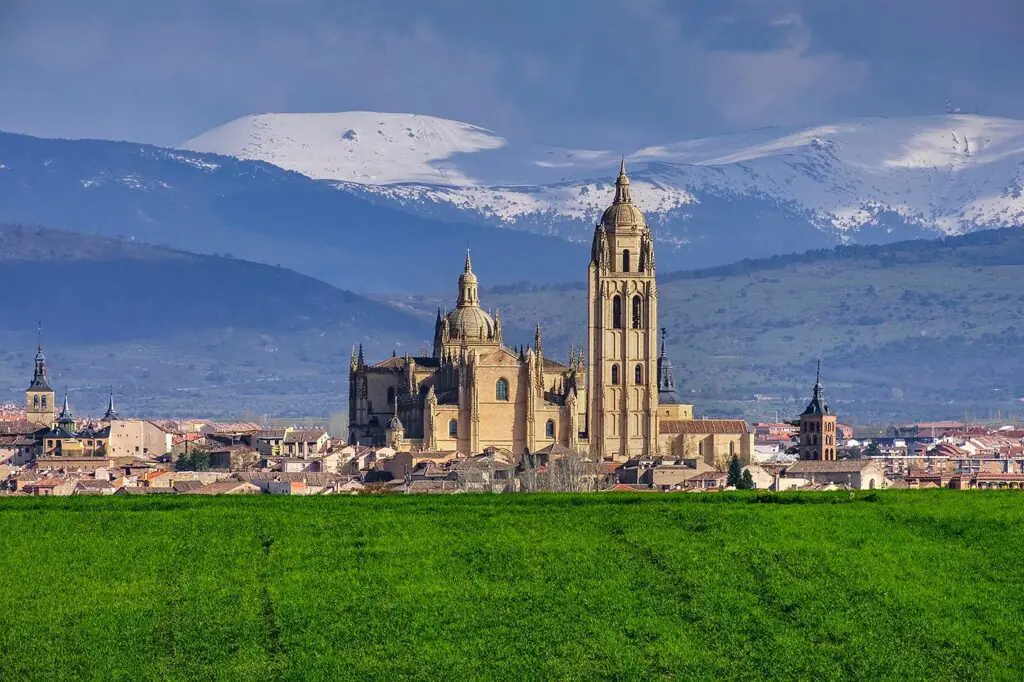
Twenty-seven minutes northwest by AVE (plus the short bus into town), Segovia leads with the object nothing prepares you for: the Roman aqueduct — 28 meters at its highest, some 20,000 granite blocks, no mortar — striding across the Plaza del Azoguejo as casually as if the second century were last Tuesday. Stand under it first; climb the side stairs for the top-level view second.
The Alcázar anchors the far end: the ship-prowed castle on its cliff wedge — royal residence of Isabel and Fernando, Disney-cited, and better inside than its silhouette promises. The palace-and-museum circuit runs about 45 minutes, the Tower of Juan II visit is capped at 25 (buy it as the add-on and climb for the full Castilian panorama), high-season security lines run long (book online, go early), and a free Tuesday-afternoon window exists for EU citizens at the ticket office. The cathedral between — the “Lady of Cathedrals,” the last Gothic one Spain built — completes the golden-stone spine.
The lunch is the third monument: cochinillo — roast suckling pig, carved theatrically with the edge of a plate at the institutions that invented the gesture — is Segovia’s civic dish, ordered by conviction and napped after. The frame: aqueduct, Alcázar, cochinillo, dusk train — the region’s most efficient astonishment.
Read the full Segovia day-trip page.
El Escorial & the Sierra — The Granite King
An hour northwest by Cercanías commuter train, San Lorenzo de El Escorial is Philip II’s statement in granite: monastery, palace, basilica, library, and royal pantheon in one gridiron colossus — the escorial of an empire at its peak, built austere on purpose and overwhelming by sheer size.
The mechanics, current: closed Mondays, tickets on Patrimonio Nacional’s official portal (entry routes can shift with restoration works — the site posts the current door), last entry well before closing, and free late-afternoon windows on Wednesdays and Sundays with conditions worth checking on the official page — booked ahead where required. The visit’s spine: the basilica (free, closed during services), the Pantheon of Kings’ marble spiral of monarchs, the library’s frescoed vault over chained volumes, and the Habsburg apartments’ deliberate plainness against the Bourbon additions’ silk. Allow three hours; the scale is the point.
The stack: the town’s arcaded streets handle lunch, the Silla de Felipe II viewpoint frames the monastery against the Guadarrama the way the king watched it rise, and the sierra’s granite trails (La Herrería’s oak woods at the door) add the walking hour. This is the heavyweight history day — cool stone in summer, austere splendor year-round — and it pairs well with the sierra’s quieter mountain villages for drivers extending it.
Read the full El Escorial day-trip page.
Ávila — The Walls
Ninety minutes northwest (Cercanías or regional trains), Ávila is Europe’s most complete walled city: two and a half kilometers of eleventh-century curtain, 87 towers, nine gates — the whole medieval enclosure intact and walkable along two restored rampart stretches, with the granite plain of Castile rolling to the sierra beyond. The walls are the visit; everything else arranges itself around them.
The circuit: the rampart walk first (the Puerta del Alcázar and Casa de las Carnicerías access points; the longer stretch is worth its ticket), then the cathedral — half church, half fortress, its apse built directly into the wall as a bastion — and the Teresa layer: the convent over the saint’s birthplace, the relics displayed with Castilian directness, and the Cuatro Postes viewpoint across the river, where the whole circuit lights up at dusk, and every photographer in Ávila is there for it.
The eating layer: chuletón de Ávila — the region’s massive veal chop — and the yemas de Santa Teresa (egg-yolk sweets the convents perfected) split the carnivore-and-pilgrim registers. Ávila is a half day of walls-and-cathedral stretched pleasantly by lunch — which is why it pairs so often with Segovia on driving and tour itineraries — and it runs cooler than Madrid in every season; the highest provincial capital in Spain wears a jacket.
Read the full Ávila day-trip page.
Cuenca — The Hanging Houses
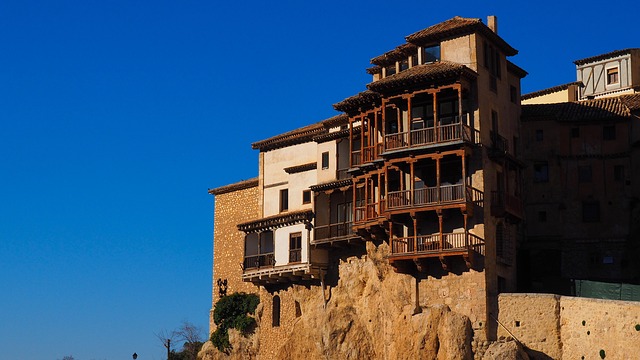
Under an hour east by AVE, Cuenca hangs its medieval self between two river gorges: the Casas Colgadas — the hanging houses cantilevered over the Huécar’s cliff — are the emblem, photographed correctly from the San Pablo footbridge, whose vertiginous crossing is itself half the visit. The old town climbs behind: the cathedral (Spain’s first Gothic, with startling modern stained glass), the Plaza Mayor’s arcades, and lanes that end in sky where the gorge takes over.
The unexpected layer: Cuenca is a modern-art capital of long standing — the Museum of Spanish Abstract Art occupies the hanging houses themselves, its Zóbel-founded collection (Chillida, Tàpies, Saura) hung against whitewash and gorge-light in one of Europe’s great museum settings — and the Fundación Antonio Pérez’s converted convent extends the argument. The pairing of eleventh-century cliff town and mid-century abstraction is Cuenca’s whole personality, and it works.
The stack: the Júcar gorge’s riverside walk, the Ciudad Encantada’s karst rock forest (thirty minutes by car, the geology-as-sculpture park), and morteruelo-and-ajoarriero for the hearty local table. AVE out, footbridge shudder, abstract art, gorge lunch, AVE home — the connoisseur’s pick on this list and the least crowded of the five.
Read the full Cuenca day-trip page.
The Free Hours, the Mercados & Madrid Itself
The museum arithmetic that changes trips: the Prado opens free in its final two hours daily (evenings Monday–Saturday, late Sunday afternoon — the queue forms early and moves fast; pick one wing and commit), the Reina Sofía runs its own free evening windows (Guernica with breathing room), and the Thyssen completes the triangle at gentler density. The paid strategy is the opposite hour: opening time, one museum per day, and the Goya black paintings or Bosch’s Garden alone worth the discipline. The Royal Palace books timed slots on the Patrimonio Nacional portal; the changing of the guard (Wednesdays, with the full ceremony monthly) is the free spectacle.
The living city: the mercado sort — San Miguel for the polished graze at polished prices, Antón Martín and Vallehermoso for the version Madrileños eat — the menú del día as lunch’s institutional bargain, cocido madrileño attempted once and respectfully, and the churros-con-chocolate ritual at the famous 24-hour address, correct at breakfast and more correct at 3 a.m. The vermut hour and the gambas al ajillo sizzle cover the aperitif; the tapa-free-with-drink custom is patchier here than in the south, so order like you mean it.
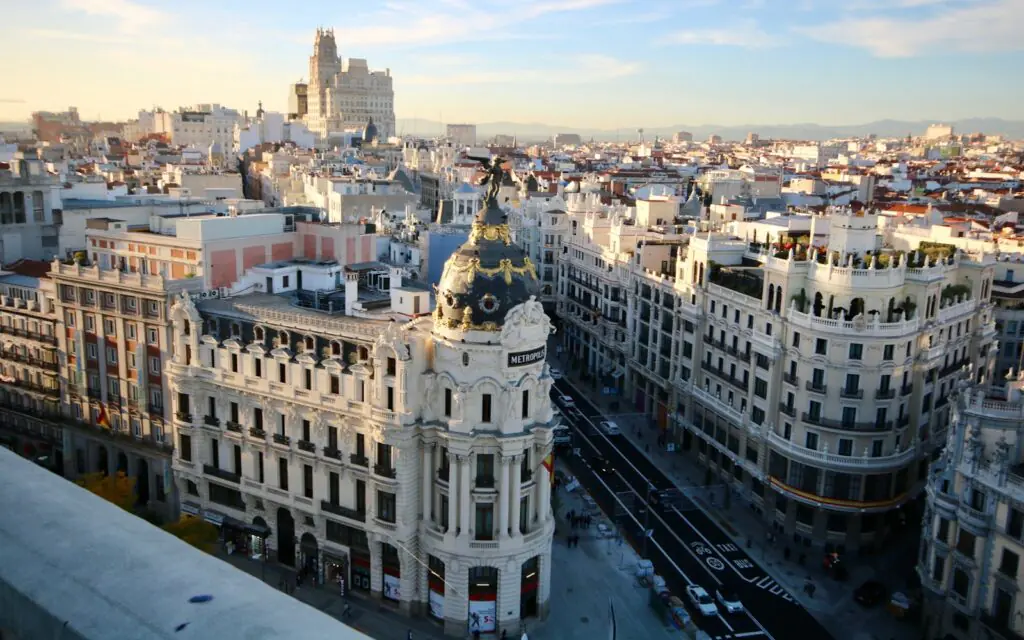
A few rules finish the picture: Retiro’s Crystal Palace and rowboats anchor the Sunday, the Rastro flea market owns Sunday morning (pockets zipped), the Gran Vía is theatre-and-shopping density managed rather than savored, and the rooftop-bar circuit (Círculo de Bellas Artes the classic) sells the sunset the streets hide. Season math: May–June and September–October are the windows; August heats past 35 and empties the locals (the museums’ air conditioning becomes a strategy); San Isidro (mid-May) dresses the city in its own festival; and the two-hour lunch is not a delay in the schedule — it is the schedule.
Full day-trip pages: Salamanca.
Full day-trip pages: Aranjuez.
Frequently Asked Questions
Toledo or Segovia with one day?
Toledo for depth — three faiths, El Greco, the cathedral — thirty-three AVE minutes away. Segovia for astonishment — the aqueduct, the ship-castle, cochinillo — twenty-seven. Both punish midday arrivals; the early train beats the coaches by two hours.
When is El Escorial free?
Late-afternoon windows on Wednesdays and Sundays, with conditions and advance-booking rules on Patrimonio Nacional’s official page — and it closes Mondays outright. Standard tickets book on the same portal; allow three hours for the complex.
How does the Segovia Alcázar tower work?
As a capped add-on: the Tower of Juan II visit runs 25 minutes maximum, bought with the palace-and-museum ticket (about 45 minutes itself). Book online in season — the security line, not the ticket office, is the queue that grows.
When is the Prado free?
Its final two hours daily — weekday and Saturday evenings, late Sunday afternoon — with the Reina Sofía running its own free windows for Guernica. Queues form early and move fast; pick one wing and commit.
Is Cuenca worth it against the famous three?
For the right visitor, most of all — hanging houses over a gorge, Spain’s best-set abstract-art museum inside them, and a footbridge crossing that doubles as the thrill ride. Under an hour by AVE and the least crowded entry on the list.